

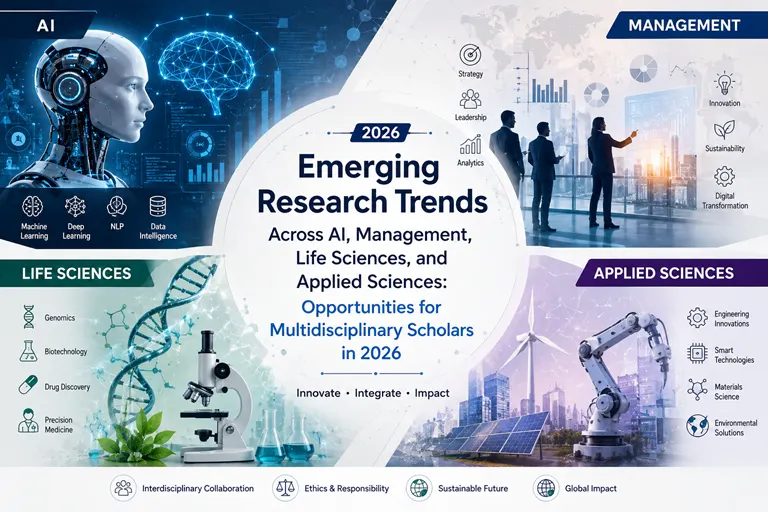
Emerging Research Trends Across AI, Management, Life Sciences, and Applied Sciences: Opportunities for Multidisciplinary Scholars in 2026
Emerging Research Trends Across AI, Management, Life Sciences, and Applied Sciences: Opportunities for Multidisciplinary Scholars in 2026
The scientific landscape is evolving rapidly. The boundaries that once separated disciplines such as artificial intelligence, management, biotechnology, healthcare, environmental science, and engineering are becoming increasingly blurred. Today's most influential discoveries often emerge at the intersection of multiple domains rather than within a single academic field.
Researchers, institutions, and funding agencies are increasingly supporting interdisciplinary projects that address complex global challenges including climate change, digital transformation, healthcare innovation, sustainable development, and intelligent decision-making systems. As a result, multidisciplinary journals are becoming essential platforms for disseminating integrated scientific knowledge.
The International Research Journal of Scientific Reports and Reviews (IRJSRR) recognizes the importance of interdisciplinary scholarship and welcomes research that bridges traditional disciplinary boundaries. For scholars planning future research projects, understanding emerging trends can help identify high-impact topics and improve publication opportunities.
This article explores some of the most significant research directions expected to shape scientific inquiry in 2026 and beyond.
The Rise of Interdisciplinary and Convergent Research
Modern scientific problems are too complex to be solved through a single discipline. Researchers increasingly combine methods and theories from various fields to generate innovative solutions.
Examples include:
- Artificial Intelligence in healthcare
- Data analytics in environmental management
- Biotechnology and computational modeling
- Digital transformation in business management
- Sustainable engineering and smart agriculture
- Machine learning in pharmaceutical sciences
Convergent research allows scientists to address societal challenges more effectively while creating new opportunities for collaboration and publication.
Artificial Intelligence Research Trends in 2026
Artificial Intelligence continues to influence nearly every academic discipline. Rather than being confined to computer science, AI has become a foundational technology across healthcare, business, engineering, and life sciences.
Generative AI for Scientific Discovery
Generative AI is increasingly used to:
- Develop scientific hypotheses
- Generate synthetic datasets
- Assist literature reviews
- Accelerate drug discovery
- Support academic writing and data interpretation
Researchers are now exploring how AI systems can collaborate with scientists to improve the efficiency of research processes.
Explainable and Trustworthy AI
As AI systems become more integrated into decision-making, transparency and accountability have become critical research priorities.
Important topics include:
- Explainable AI models
- Ethical machine learning
- Bias detection and mitigation
- Responsible AI governance
- AI regulations and policy frameworks
These areas are receiving substantial attention from both academic institutions and policymakers worldwide.
AI for Healthcare and Precision Medicine
Artificial intelligence is transforming medical diagnostics and personalized healthcare through:
- Medical image analysis
- Predictive disease modeling
- Genomic data interpretation
- Clinical decision support systems
- Personalized treatment planning
The integration of AI with life sciences represents one of the most promising multidisciplinary research directions.
Human-Centered Artificial Intelligence
Future AI systems are increasingly designed to enhance human capabilities rather than replace them.
Research opportunities include:
- Human-AI collaboration
- Cognitive computing
- Intelligent educational systems
- Adaptive interfaces
- AI-assisted decision support
Emerging Management Research Trends
Business and management research is also experiencing substantial transformation due to digital technologies and global economic changes.
Digital Transformation and Organizational Innovation
Organizations continue to invest heavily in digital technologies to improve efficiency and competitiveness.
Research opportunities include:
- Digital business models
- Technology adoption strategies
- Organizational resilience
- Innovation management
- Digital leadership
The relationship between digital transformation and organizational performance remains an important research area.
Data-Driven Decision Making
Businesses increasingly rely on data analytics to guide strategic decisions.
Key topics include:
- Business intelligence systems
- Predictive analytics
- Big data management
- Customer analytics
- Decision support frameworks
The integration of AI and management science is creating entirely new research domains.
Sustainable Business and ESG Research
Environmental, Social, and Governance (ESG) principles are becoming central to corporate strategies.
Emerging topics include:
- Sustainable finance
- Green business models
- Corporate social responsibility
- Circular economy
- ESG performance measurement
Researchers are examining how sustainability initiatives contribute to long-term organizational success.
Future of Work and Workforce Transformation
Technological advancements are changing how organizations operate.
Important research areas include:
- Remote work models
- Hybrid workplaces
- Workforce automation
- Employee well-being
- Digital skills development
- Organizational adaptability
Understanding the future workforce will remain a major management research priority.
Emerging Trends in Life Sciences Research
Life sciences continue to generate groundbreaking discoveries with significant societal implications.
Precision Medicine and Personalized Healthcare
Advances in genomics and biotechnology are enabling highly individualized healthcare solutions.
Research opportunities include:
- Genomic medicine
- Biomarker discovery
- Personalized therapeutics
- Pharmacogenomics
- Precision diagnostics
These areas are expected to experience significant growth over the coming years.
Microbiome Research
The human microbiome has become one of the most exciting areas in biomedical science.
Research focuses include:
- Gut microbiota and disease
- Microbiome-based therapeutics
- Nutrition and metabolic health
- Immune system interactions
- Personalized nutrition
The interdisciplinary nature of microbiome research creates numerous publication opportunities.
Biotechnology and Synthetic Biology
Synthetic biology is transforming medicine, agriculture, and environmental science.
Important topics include:
- Gene editing technologies
- CRISPR applications
- Engineered microorganisms
- Bio-manufacturing
- Synthetic biological systems
These technologies are expected to have far-reaching impacts across multiple industries.
One Health and Global Health Research
The One Health concept recognizes the interconnectedness of human, animal, and environmental health.
Research opportunities include:
- Emerging infectious diseases
- Climate and health interactions
- Antimicrobial resistance
- Public health preparedness
- Environmental epidemiology
This multidisciplinary approach is becoming increasingly important for addressing global health challenges.
Emerging Trends in Applied Sciences
Applied sciences focus on translating scientific discoveries into practical solutions.
Smart and Sustainable Technologies
Research on sustainability continues to expand across engineering and applied sciences.
Key areas include:
- Renewable energy systems
- Smart cities
- Energy-efficient technologies
- Sustainable materials
- Environmental monitoring systems
Governments and industries are heavily investing in sustainable innovation initiatives.
Internet of Things and Intelligent Systems
The Internet of Things is reshaping industries by enabling connected and data-driven environments.
Research topics include:
- Smart manufacturing
- Intelligent transportation systems
- Industrial automation
- Smart healthcare devices
- Agricultural monitoring technologies
The integration of IoT and AI represents a highly active area of research.
Advanced Materials and Nanotechnology
Material science innovations are creating new possibilities in healthcare, electronics, and environmental technologies.
Research opportunities include:
- Nanomaterials
- Biomedical materials
- Energy storage technologies
- Smart materials
- Environmental remediation technologies
Climate Change and Environmental Science
Climate-related research is receiving unprecedented global attention.
Emerging topics include:
- Carbon capture technologies
- Climate adaptation strategies
- Environmental sustainability
- Biodiversity conservation
- Circular economy solutions
Interdisciplinary environmental research is expected to remain a major scientific priority throughout the coming decade.
The Growing Importance of Multidisciplinary Research Publications
Funding agencies increasingly encourage collaborative and interdisciplinary projects because many global challenges require integrated scientific solutions.
Multidisciplinary journals play an essential role by:
- Facilitating knowledge exchange across disciplines
- Promoting collaborative research
- Increasing research visibility
- Encouraging innovative methodologies
- Supporting real-world problem-solving
Researchers who can integrate methods and perspectives from multiple disciplines often achieve greater academic impact.
Publishing Opportunities for Interdisciplinary Scholars
Publishing multidisciplinary research requires selecting journals that appreciate cross-disciplinary perspectives.
Authors should consider:
- Clear research objectives
- Robust methodology
- Practical implications
- Interdisciplinary relevance
- Ethical research practices
- Comprehensive literature integration
The International Research Journal of Scientific Reports and Reviews provides a valuable platform for researchers seeking to publish innovative multidisciplinary studies and scientific reviews.
Frequently Asked Questions
Why is interdisciplinary research becoming more important?
Complex global problems such as healthcare challenges, climate change, and digital transformation require expertise from multiple disciplines.
Which research field is expected to grow the fastest in 2026?
Artificial intelligence integrated with healthcare, management, biotechnology, and environmental sciences is expected to experience significant growth.
Are multidisciplinary journals suitable for early-career researchers?
Yes. Multidisciplinary journals provide opportunities to publish innovative studies that combine methods and perspectives from multiple domains.
What are the benefits of publishing interdisciplinary research?
Interdisciplinary research often achieves broader impact, attracts wider readership, and addresses real-world challenges more effectively.
Which topics offer strong publication opportunities in 2026?
AI applications, sustainability research, precision medicine, digital transformation, synthetic biology, and intelligent systems are among the most promising areas.
Conclusion
Scientific research is entering an era defined by collaboration, convergence, and innovation. Artificial intelligence, management science, life sciences, and applied sciences are increasingly interconnected, creating new opportunities for transformative discoveries and practical solutions.
Researchers who embrace interdisciplinary thinking and develop collaborative approaches will be well positioned to address society's most pressing challenges and contribute meaningfully to scientific progress.
The International Research Journal of Scientific Reports and Reviews encourages scholars, scientists, and practitioners to explore these emerging research directions and contribute high-quality scientific reports and reviews that advance multidisciplinary knowledge and innovation.
For editors and institutions planning to launch or modernize multidisciplinary journals, professional support is available for journal website development, editorial workflow implementation, ISSN consulting, Crossref DOI guidance, and journal management solutions through platforms such as ScholarJMS, OJSCloud, GetDOI, and Scholar9.