


How to Get ISSN and Crossref DOI for a New Multidisciplinary Journal: A Complete Guide for Journal Founders in 2026
How to Get ISSN and Crossref DOI for a New Multidisciplinary Journal: A Complete Guide for Journal Founders in 2026
Launching a scholarly journal involves much more than publishing articles online. To establish credibility, improve discoverability, and build trust among authors and readers, every modern journal should plan for two essential identifiers from the beginning:
- International Standard Serial Number (ISSN)
- Digital Object Identifier (DOI)
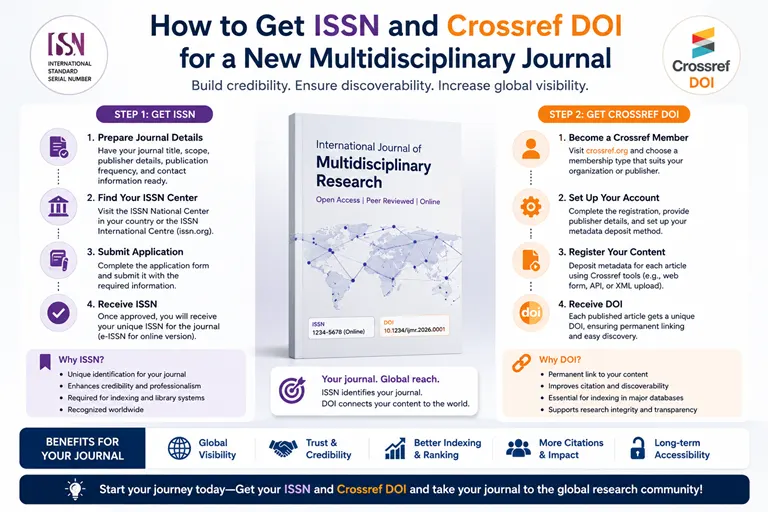
For multidisciplinary journals, these identifiers are particularly important because they support international visibility, indexing readiness, and long-term scholarly recognition.
Many new journal founders are unfamiliar with the processes involved in obtaining ISSN and implementing Crossref DOI workflows. As a result, journals often experience delays, technical challenges, and avoidable mistakes during their early stages of development.
This guide explains how new multidisciplinary journals can successfully obtain ISSN and Crossref DOI support in 2026 and establish a strong foundation for long-term growth.
Why ISSN and DOI Matter for Academic Journals
A journal's credibility depends on more than its editorial quality.
Modern scholarly publishing also requires:
- Professional journal infrastructure
- Standardized metadata
- Persistent identifiers
- Transparent publishing practices
- International discoverability
ISSN and DOI are fundamental components of this infrastructure.
What Is an ISSN?
An ISSN is an eight-digit international identifier assigned to serial publications, including scholarly journals.
The ISSN helps:
- Identify journals uniquely
- Improve library cataloguing
- Support indexing applications
- Distinguish journals with similar titles
- Increase professional credibility
ISSN does not indicate quality or indexing status, but it serves as an important identification standard in scholarly publishing.
Why New Journals Need an ISSN
Obtaining an ISSN provides several advantages.
Professional Recognition
An ISSN demonstrates that the journal is operating as a legitimate serial publication.
Improved Discoverability
Libraries, databases, and academic institutions frequently use ISSN information when cataloguing journals.
Support for Indexing Applications
Many indexing services request ISSN details during evaluation.
Long-Term Identity
ISSN provides a stable identifier that remains associated with the journal throughout its publication life.
Requirements for Obtaining an ISSN
Although requirements vary slightly among countries, most ISSN agencies expect journals to have:
- A functioning journal website
- Clearly displayed journal title
- Editorial board information
- Aims and scope statement
- Publication frequency
- Author guidelines
- Publication ethics policies
- Contact information
- Information about the publisher
Preparing these elements before applying can significantly improve the chances of a smooth application process.
Why Website Readiness Is Important Before Applying for ISSN
Many new journals apply for ISSN before their websites are fully prepared.
This often causes unnecessary delays.
A journal website should include:
- Home page
- About Journal
- Editorial Board
- Aims and Scope
- Author Guidelines
- Publication Ethics
- Contact Page
- Online Submission Information
Website readiness demonstrates professionalism and publishing intent.
Why Many Journal Founders Seek ISSN Consulting Support
The ISSN process can sometimes be confusing, particularly for first-time journal founders.
Common challenges include:
- Unclear requirements
- Incomplete website preparation
- Metadata inconsistencies
- Publishing policy gaps
- Delays in communication
OJSCloud provides professional support and consulting for journals seeking assistance with:
- Journal website readiness
- ISSN consulting
- Publishing infrastructure
- Journal launch planning
- Editorial setup
Professional guidance often helps journals avoid common mistakes during the application process.
Step-by-Step Guide to Obtaining ISSN
Step 1: Finalize the Journal Title
Select a unique and appropriate title that reflects the journal's objectives and subject coverage.
Step 2: Build the Journal Website
Create a professional and fully functional website containing all essential information.
Step 3: Establish Editorial Policies
Prepare:
- Peer review policies
- Publication ethics
- Copyright information
- Open access statements
- Retraction policies
Step 4: Define Publication Frequency
Determine whether the journal will publish:
- Annual issues
- Biannual issues
- Quarterly issues
- Continuous publication
Step 5: Submit the ISSN Application
Apply through the appropriate national ISSN agency and provide the required documentation.
Step 6: Respond to Any Clarification Requests
Some agencies may request additional information before issuing the ISSN.
What Is a DOI?
A Digital Object Identifier is a persistent identifier assigned to digital scholarly content.
DOIs provide permanent links to:
- Journal articles
- Research datasets
- Conference papers
- Reports
- Supplementary materials
The DOI system ensures that scholarly content remains discoverable even if website structures change.
Why Crossref DOI Is Important for Journals
Crossref DOI implementation provides several benefits.
Improved Discoverability
Articles become easier to locate and cite.
Better Citation Tracking
DOIs enable reliable citation linking and reference management.
Professional Publishing Standards
Most reputable scholarly journals now assign DOIs to published articles.
Enhanced Metadata Distribution
DOIs facilitate metadata sharing across scholarly databases and systems.
Long-Term Accessibility
Persistent identifiers improve long-term preservation and accessibility.
Why DOI Planning Should Begin Early
Many journals postpone DOI implementation until after publishing articles.
This approach often creates challenges because:
- Metadata structures may be incomplete.
- Citation workflows may require revision.
- Publication systems may need modification.
Planning DOI workflows from the beginning simplifies future operations.
Understanding Crossref Membership and DOI Registration
Crossref is one of the world's leading DOI registration agencies for scholarly content.
To assign DOIs, journals generally need:
- Publishing infrastructure
- Article metadata
- Website readiness
- Long-term content availability
- DOI management workflows
Many journals seek professional guidance because the technical and administrative requirements can be complex.
How GetDOI Supports New Journals
GetDOI provides support and guidance for journals seeking assistance with:
- Crossref DOI planning
- Metadata workflows
- DOI implementation
- Registration guidance
- Publishing best practices
Early DOI planning can significantly improve long-term publishing efficiency.
Need Help with ISSN and Crossref DOI?
We can help with:
- ISSN consulting
- Journal website readiness
- DOI planning and guidance
- Metadata preparation
- Publishing workflow setup
- Journal launch consulting
- Editorial infrastructure planning
WhatsApp: +91 82003 85143
Email: inquiry@ojscloud.com
Why Multidisciplinary Journals Must Prioritize Metadata Quality
Multidisciplinary journals frequently publish articles from diverse disciplines and therefore require strong metadata practices.
Proper metadata improves:
- Discoverability
- Search engine visibility
- Citation tracking
- Indexing readiness
- Long-term accessibility
Metadata planning should begin before the publication of the first issue.
The Importance of Journal Management Infrastructure
A journal's technical infrastructure directly influences its ability to manage ISSN and DOI workflows efficiently.
Modern journal platforms should support:
- Manuscript submission
- Editorial workflows
- Metadata management
- Article publication
- DOI integration
- Long-term scalability
ScholarJMS provides journal website development and editorial workflow solutions that help journals establish strong publishing foundations.
Why Planning Early Saves Time and Resources
Journals that address ISSN and DOI requirements during the initial planning stages often experience:
- Faster launch timelines
- Better workflow organization
- Improved metadata quality
- Greater publishing consistency
- Better indexing readiness
Early planning is one of the most effective ways to build a sustainable scholarly publication.
Common Mistakes New Journals Should Avoid
New journal founders often encounter problems because they:
- Apply for ISSN before website completion.
- Delay DOI planning.
- Ignore metadata requirements.
- Establish weak editorial policies.
- Use inadequate publishing infrastructure.
- Lack long-term publishing strategies.
Avoiding these mistakes significantly improves the probability of long-term success.
Building Trust Through Transparency
Modern scholarly publishing increasingly emphasizes:
- Research integrity
- Transparency
- Accountability
- Ethical publishing
Scholar9 contributes to transparent scholarly communication and research trust initiatives that support modern publishing practices.
Frequently Asked Questions
Is ISSN mandatory for a journal?
An ISSN is not always legally mandatory, but it is highly recommended because it improves professional credibility and discoverability.
Can a journal obtain DOI without ISSN?
In many situations, DOI planning can begin independently. However, journals generally benefit from having both identifiers as part of their publishing infrastructure.
How long does it take to receive an ISSN?
The timeline varies according to the national ISSN agency and the completeness of the journal's application.
Why should journals plan DOI workflows before publishing articles?
Early planning improves metadata quality, workflow efficiency, and long-term publishing consistency.
Is DOI registration difficult for new journals?
The process can be technically complex for first-time publishers, which is why many journals seek professional guidance.
Can professional services help with ISSN and DOI preparation?
Yes. Consulting services can assist journals with website readiness, metadata preparation, workflow design, and publishing infrastructure.
Conclusion
Obtaining ISSN and implementing Crossref DOI workflows are essential steps in building a credible and sustainable multidisciplinary journal.
ISSN provides professional identity and improves discoverability, while DOI implementation strengthens citation management, metadata distribution, and long-term accessibility.
For journal founders, planning these elements from the beginning can prevent future complications and establish a strong foundation for growth.
As scholarly publishing becomes increasingly digital and interconnected, journals that invest in professional infrastructure, metadata quality, and publishing standards will be better positioned to attract authors, improve visibility, and achieve long-term success.
If you are planning to launch a new multidisciplinary journal or require guidance regarding journal websites, ISSN consulting, Crossref DOI implementation, editorial workflows, or publishing infrastructure, professional support can simplify the process and help you build a strong and sustainable scholarly publication.
Contact Us
WhatsApp: +91 82003 85143
WhatsApp Direct: https://wa.me/918200385143
Email: inquiry@ojscloud.com