


How to Start an Online Multidisciplinary Research Journal in 2026: A Complete Guide for Universities, Researchers, and Scholarly Societies
How to Start an Online Multidisciplinary Research Journal in 2026: A Complete Guide for Universities, Researchers, and Scholarly Societies
The global scholarly publishing landscape is changing rapidly. Universities, research institutions, academic societies, and independent scholarly groups are increasingly establishing their own journals to promote research dissemination, encourage interdisciplinary collaboration, and provide publishing opportunities for emerging researchers.
The growth of digital publishing technologies has made launching a scholarly journal more accessible than ever before. However, creating a successful academic journal involves far more than building a website and publishing articles online.
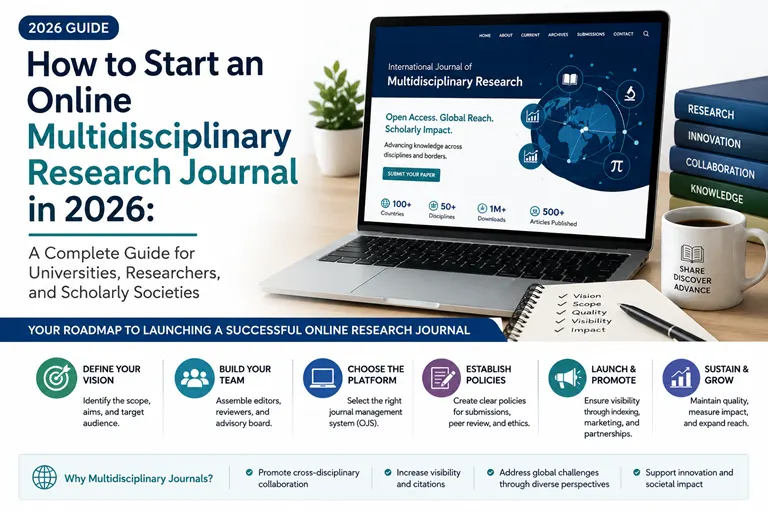
A modern journal requires a strong editorial vision, robust publishing infrastructure, transparent workflows, ethical policies, and long-term sustainability planning.
For multidisciplinary journals, the opportunity is even greater. Modern scientific challenges such as artificial intelligence, climate change, digital transformation, healthcare innovation, and sustainability demand collaborative research that crosses traditional disciplinary boundaries.
This guide explains how to start an online multidisciplinary research journal in 2026 and outlines the essential steps required for long-term success.
Why Launch a Multidisciplinary Research Journal?
Multidisciplinary journals provide a platform for research that integrates knowledge from multiple disciplines.
They offer several advantages:
- Encourage interdisciplinary collaboration.
- Increase research visibility.
- Address complex societal challenges.
- Promote innovation and knowledge exchange.
- Support emerging research areas.
- Attract diverse authors and readers.
As research becomes increasingly interconnected, multidisciplinary journals are playing a more important role in global scholarship.
Step 1: Define the Journal's Mission and Scope
Every successful journal begins with a clear mission.
Before launching a journal, publishers should answer several questions:
- What type of research will the journal publish?
- Who is the target audience?
- What disciplines will be covered?
- What makes the journal different from existing journals?
- Will the journal be open access?
A well-defined scope helps authors understand the journal's objectives and improves long-term positioning.
Developing a Strong Aims and Scope Statement
The aims and scope should clearly define:
- Subject coverage
- Types of manuscripts accepted
- Target readership
- Research priorities
- Interdisciplinary focus
- Ethical standards
A clear scope also improves discoverability and helps attract suitable submissions.
Step 2: Establish the Editorial Structure
Editorial quality is one of the most important indicators of journal credibility.
A new journal should establish:
- Editor-in-Chief
- Associate Editors
- Editorial Board Members
- Advisory Board
- Managing Editor
- Technical Support Team
For multidisciplinary journals, editorial diversity is essential because submissions may come from various scientific domains.
Building an International Editorial Board
An international editorial board can:
- Enhance credibility
- Improve manuscript quality
- Attract submissions
- Expand global reach
- Support indexing readiness
Many indexing agencies also consider editorial diversity as a positive indicator of journal quality.
Step 3: Develop Journal Policies
A journal must establish clear policies before accepting submissions.
Important policies include:
- Peer review process
- Publication ethics
- Plagiarism policy
- Open access policy
- Copyright policy
- Data availability policy
- Conflict of interest policy
- Retraction and correction procedures
Well-documented policies improve transparency and author confidence.
Step 4: Create the Journal Website
The journal website is the public face of the publication.
A professional journal website should include:
- Home page
- About Journal
- Aims and Scope
- Editorial Board
- Author Guidelines
- Publication Ethics
- Current Issue
- Archives
- Contact Information
- Online Submission System
Modern authors expect intuitive, secure, and mobile-friendly journal websites.
Choosing the Right Journal Management Platform
One of the most important decisions is selecting the journal management system.
Publishers generally choose between:
- Open-source systems
- Custom-built platforms
- Fully managed journal management solutions
The platform should support:
- Manuscript submission
- Reviewer assignment
- Editorial decisions
- Article publication
- Metadata management
- DOI integration
- Long-term scalability
Why Many New Journals Choose Modern Publishing Platforms
Many new journals prefer managed publishing solutions because they eliminate technical complexity and allow editors to focus on editorial quality.
ScholarJMS provides:
- Journal website development
- Manuscript submission management
- Editorial workflow systems
- Article publishing infrastructure
- User-friendly administration
- Long-term technical support
For institutions launching their first journal, professional publishing infrastructure can significantly simplify the process.
Need Help Launching Your Journal?
We can assist with:
- New journal website setup
- ScholarJMS implementation
- Editorial workflow configuration
- Journal launch consulting
- Publishing strategy development
- Technical support and training
WhatsApp: +91 82003 85143
Email: inquiry@ojscloud.com
Step 5: Obtain ISSN for the Journal
An International Standard Serial Number (ISSN) is an essential identifier for scholarly journals.
Before applying for ISSN, journals generally need:
- A functional website
- Editorial information
- Publishing policies
- Journal metadata
- Clearly defined publication frequency
Many new publishers find the ISSN process challenging because requirements vary between countries.
Why ISSN Planning Matters
Proper ISSN preparation:
- Establishes journal identity
- Improves professional credibility
- Supports indexing applications
- Facilitates library registration
- Enhances discoverability
OJSCloud provides consulting support for journals seeking assistance with ISSN readiness and journal launch planning.
Step 6: Plan DOI Registration from the Beginning
Many journals delay DOI implementation until after publication. This often creates unnecessary challenges.
Digital Object Identifiers are now considered essential for modern scholarly publishing.
DOIs help:
- Improve citation tracking
- Enhance discoverability
- Facilitate metadata distribution
- Support indexing initiatives
- Increase journal credibility
Why Early DOI Planning Is Important
Early DOI planning allows journals to:
- Build proper metadata workflows
- Standardize article publishing processes
- Improve long-term scalability
- Simplify indexing preparation
GetDOI provides support and guidance for journals seeking assistance with Crossref DOI registration and workflow implementation.
Need Support with ISSN and Crossref DOI?
We can help with:
- ISSN consulting
- Crossref DOI planning
- Journal metadata setup
- Publication workflow design
- Article registration guidance
- Journal launch support
WhatsApp: +91 82003 85143
Email: inquiry@ojscloud.com
Step 7: Establish the Peer Review Workflow
Peer review remains the foundation of scholarly publishing.
A journal should determine:
- Single-blind review
- Double-blind review
- Open review
- Transparent review
The review workflow should include:
- Submission screening
- Reviewer selection
- Editorial decisions
- Revision management
- Final publication approval
Efficient workflows improve author satisfaction and editorial productivity.
Step 8: Develop Publication Ethics and Integrity Policies
Research integrity is becoming increasingly important.
Journals should establish policies regarding:
- Plagiarism
- Duplicate publication
- Data manipulation
- Authorship disputes
- Conflicts of interest
- Ethical approval requirements
Strong ethical standards improve journal reputation and trust.
The Future of Transparent Peer Review
The scholarly community is increasingly interested in transparency and research trust.
Scholar9 contributes to the development of transparent scholarly communication ecosystems that promote research integrity and accountability.
Step 9: Prepare for Indexing and Visibility
Although new journals should focus primarily on quality, long-term indexing preparation is equally important.
Journals should work toward:
- Consistent publication schedules
- Strong editorial standards
- Proper metadata management
- DOI registration
- Ethical publishing practices
- International participation
Indexing readiness should be considered from the beginning rather than after several years of operation.
Step 10: Build a Sustainable Growth Strategy
Many journals struggle not because of poor research quality but because of inadequate operational planning.
A sustainability strategy should include:
- Editorial succession planning
- Financial management
- Marketing strategy
- International partnerships
- Technology upgrades
- Author engagement initiatives
A journal should be viewed as a long-term scholarly institution rather than a short-term project.
Common Mistakes New Journals Should Avoid
New journal founders frequently encounter avoidable challenges.
Common mistakes include:
- Undefined journal scope
- Weak editorial boards
- Poor website design
- Delayed DOI planning
- Inadequate publication ethics policies
- Irregular publication schedules
- Lack of technical support
- Insufficient metadata management
Avoiding these mistakes significantly improves the probability of long-term success.
Why Multidisciplinary Journals Have Strong Growth Potential
Research problems are becoming increasingly interconnected.
The future of scholarship lies in:
- Interdisciplinary collaboration
- Evidence integration
- Cross-sector partnerships
- Global research networks
- Technology-enabled knowledge sharing
Multidisciplinary journals are uniquely positioned to support these developments and facilitate scientific progress.
Frequently Asked Questions
How much does it cost to start an online journal?
Costs vary depending on website development, hosting, DOI registration, editorial management systems, and technical support requirements.
Can an individual start a scholarly journal?
Yes. However, establishing a credible editorial structure and long-term sustainability plan is essential.
Is ISSN mandatory for a journal?
Although journals may begin operations before obtaining ISSN in some cases, ISSN significantly improves credibility and discoverability.
Why are DOIs important?
DOIs improve citation tracking, article discoverability, and metadata distribution.
Which platform is best for new journals?
The answer depends on technical resources and publishing objectives. Many new journals prefer managed solutions that simplify editorial operations.
How long does it take to launch a journal?
A well-planned journal can often be established within a few months, depending on editorial preparation and technical requirements.
Conclusion
Starting an online multidisciplinary research journal in 2026 offers significant opportunities for universities, scholarly societies, and research organizations. However, successful journal publishing requires strategic planning, professional infrastructure, and long-term commitment.
A strong journal begins with a clear mission, robust editorial policies, efficient workflows, and sustainable technology solutions. Planning for ISSN, Crossref DOI registration, peer review systems, and indexing readiness from the beginning can substantially improve long-term success.
As interdisciplinary research continues to expand worldwide, multidisciplinary journals will play an increasingly important role in connecting researchers, facilitating knowledge exchange, and advancing global scholarship.
If you are planning to launch a new journal, modernize an existing publication, or require assistance with journal websites, editorial workflows, ISSN consulting, DOI implementation, or migration services, professional guidance can significantly simplify the process and help establish a strong foundation for long-term growth.
Contact Us
WhatsApp: +91 82003 85143
WhatsApp Direct: https://wa.me/918200385143
Email: inquiry@ojscloud.com