


How to Write a High-Quality Scientific Review Paper for Multidisciplinary Journal Publication
How to Write a High-Quality Scientific Review Paper for Multidisciplinary Journal Publication
Scientific knowledge is expanding at an unprecedented pace. Thousands of research articles are published every day across disciplines such as artificial intelligence, healthcare, engineering, management, environmental sciences, education, and social sciences. While this growing body of literature provides enormous opportunities for discovery, it also creates a challenge for researchers who must remain informed about rapidly evolving fields.
Scientific review papers play a crucial role in addressing this challenge. A well-written review article synthesizes existing knowledge, evaluates previous studies, identifies research gaps, and provides future directions for research and innovation.
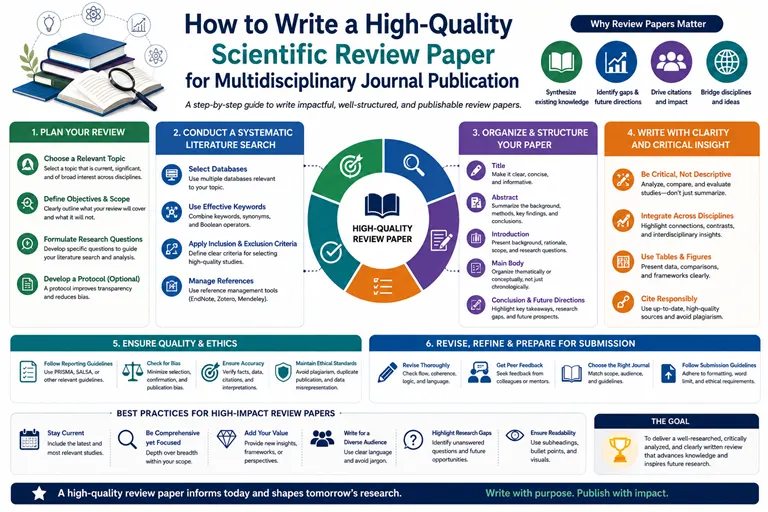
For multidisciplinary journals, review papers are particularly valuable because they help researchers from different disciplines understand emerging topics and promote knowledge integration across academic boundaries.
The International Research Journal of Scientific Reports and Reviews (IRJSRR) encourages the submission of high-quality scientific review papers that contribute to global scholarship and facilitate interdisciplinary understanding.
This article provides a practical guide to writing a publishable scientific review paper for multidisciplinary journal publication.
What Is a Scientific Review Paper?
A scientific review paper is a scholarly article that critically examines and synthesizes previously published research on a specific topic.
Unlike original research articles, review papers generally do not present new experimental findings. Instead, they evaluate existing evidence and provide insights that help researchers understand the current state of knowledge.
Review articles often become highly cited because they serve as valuable reference resources for researchers, students, and policymakers.
Why Review Papers Matter
Scientific review papers provide numerous benefits.
They:
- Summarize large volumes of literature.
- Identify research trends.
- Highlight knowledge gaps.
- Evaluate methodologies.
- Guide future research.
- Facilitate interdisciplinary learning.
- Support evidence-based decision-making.
In rapidly evolving fields, review articles often shape future research agendas.
Why Multidisciplinary Journals Value Review Articles
Modern scientific challenges rarely belong to a single discipline.
Topics such as:
- Artificial intelligence in healthcare
- Climate change and sustainability
- Digital transformation
- Precision medicine
- Smart agriculture
- Data science and public policy
require researchers to understand knowledge from multiple fields.
Review papers help bridge these disciplines and encourage collaboration.
Types of Scientific Review Papers
Choosing the appropriate type of review is the first step toward writing a high-quality article.
Narrative Review
Narrative reviews provide broad discussions of a topic and summarize important findings from previous studies.
They are suitable for:
- Emerging fields
- Interdisciplinary topics
- Theoretical discussions
Systematic Review
Systematic reviews follow predefined methods to identify, evaluate, and synthesize evidence.
They aim to minimize bias and provide comprehensive analyses.
Scoping Review
Scoping reviews map the available literature and identify research trends and gaps.
These reviews are useful when a topic is rapidly evolving.
Meta-Analysis
Meta-analysis uses statistical methods to combine findings from multiple studies.
It is commonly used in healthcare and social sciences.
Umbrella Review
Umbrella reviews synthesize evidence from multiple review articles and provide high-level summaries of existing knowledge.
The selected review type should align with the research objectives.
Step 1: Select a Relevant and Focused Topic
The quality of a review article largely depends on the quality of the research question.
An effective topic should be:
- Relevant
- Timely
- Clearly defined
- Scientifically important
- Broad enough to have sufficient literature
- Narrow enough to remain manageable
Examples include:
- Explainable Artificial Intelligence in Healthcare
- Climate-Smart Agriculture Technologies
- Digital Transformation in Higher Education
- Precision Medicine and Genomic Diagnostics
- Sustainable Supply Chain Management
Step 2: Develop Clear Research Questions
Research questions guide the entire review process.
Examples include:
- What are the major developments in this field?
- Which methodologies have been used?
- What are the existing research gaps?
- What future research directions should be considered?
Clear objectives improve the structure and quality of the review.
Step 3: Conduct a Comprehensive Literature Search
A high-quality review requires systematic literature identification.
Researchers should search:
- Scholarly databases
- Journal repositories
- Indexing platforms
- Conference proceedings
- Government reports
- Institutional publications
The search strategy should be transparent and reproducible.
Developing Search Keywords
Keywords should include:
- Main concepts
- Synonyms
- Related terminology
- Alternative spellings
A well-designed search strategy improves comprehensiveness and reduces bias.
Step 4: Screen and Select Studies
After identifying the literature, researchers should establish:
- Inclusion criteria
- Exclusion criteria
- Study selection procedures
- Eligibility requirements
This process ensures that only relevant studies are included.
Step 5: Organize and Extract Information
Researchers should systematically extract information such as:
- Author information
- Publication year
- Study objectives
- Methods used
- Key findings
- Limitations
- Recommendations
Organized data extraction simplifies analysis and writing.
Step 6: Critically Evaluate the Literature
A review article should not simply summarize studies.
Authors should:
- Compare findings.
- Identify contradictions.
- Assess methodological quality.
- Discuss strengths and weaknesses.
- Evaluate the significance of evidence.
Critical analysis is one of the defining characteristics of a high-quality review paper.
Step 7: Identify Research Gaps
One of the primary contributions of review articles is the identification of knowledge gaps.
Examples include:
- Understudied populations
- Methodological limitations
- Inconsistent findings
- Emerging technologies
- Geographic research gaps
- Lack of interdisciplinary perspectives
Research gaps provide valuable guidance for future investigations.
Step 8: Develop Future Research Directions
A strong review article should offer practical recommendations.
Examples include:
- New methodologies
- Collaborative research opportunities
- Emerging applications
- Policy implications
- Technological developments
- Interdisciplinary approaches
Forward-looking discussions significantly increase the value of review papers.
Structuring a Scientific Review Paper
Most review articles follow a structure similar to the following:
Title
The title should be:
- Informative
- Specific
- Concise
- Search-engine friendly
Abstract
The abstract should summarize:
- Background
- Objectives
- Methods
- Major findings
- Conclusions
Keywords
Select keywords that improve discoverability and accurately reflect the content.
Introduction
The introduction should explain:
- The importance of the topic
- Existing challenges
- Research objectives
- Scope of the review
Methodology
The methods section should describe:
- Search strategy
- Databases searched
- Inclusion criteria
- Exclusion criteria
- Selection procedures
Transparency improves credibility.
Results and Discussion
This section should:
- Present major themes
- Compare evidence
- Identify trends
- Discuss limitations
- Highlight research gaps
Conclusion
The conclusion should summarize:
- Current knowledge
- Key findings
- Future directions
- Practical implications
The Importance of Reporting Standards
Many journals now expect authors to follow reporting guidelines.
Examples include:
- PRISMA for systematic reviews
- Scoping review reporting guidelines
- Narrative review recommendations
Following reporting standards improves transparency and publication quality.
Common Mistakes in Review Writing
Many review papers are rejected because authors:
- Conduct inadequate literature searches.
- Merely summarize studies.
- Fail to critically analyze evidence.
- Use unclear methodologies.
- Ignore reporting standards.
- Lack focus.
- Present weak conclusions.
Avoiding these mistakes substantially improves publication success.
How to Improve the Quality of a Review Paper
Researchers should:
- Select a meaningful topic.
- Use systematic methods.
- Critically evaluate literature.
- Identify research gaps.
- Follow reporting guidelines.
- Write clearly and logically.
- Maintain methodological transparency.
High-quality review papers often become highly influential contributions.
Why Review Papers Receive High Citation Rates
Review articles frequently receive substantial citations because they:
- Serve as educational resources.
- Summarize large bodies of evidence.
- Guide future research.
- Support interdisciplinary understanding.
- Provide valuable reference materials.
For early-career researchers, writing a high-quality review article can significantly improve academic visibility.
Why Multidisciplinary Review Papers Are Increasingly Important
Modern scientific problems increasingly require interdisciplinary perspectives.
Review articles that integrate knowledge across disciplines can:
- Facilitate collaboration.
- Encourage innovation.
- Identify emerging trends.
- Support evidence-based policy.
- Accelerate scientific progress.
Multidisciplinary journals provide ideal platforms for such contributions.
The Role of Journals in Supporting High-Quality Reviews
Academic journals play an important role in:
- Encouraging methodological rigor.
- Promoting transparency.
- Supporting evidence synthesis.
- Facilitating interdisciplinary knowledge exchange.
The International Research Journal of Scientific Reports and Reviews (IRJSRR) welcomes review articles that demonstrate scientific rigor, critical analysis, and meaningful contributions to global scholarship.
Frequently Asked Questions
What is the purpose of a scientific review paper?
A review paper synthesizes and critically evaluates existing research to provide a comprehensive understanding of a topic.
Are review articles easier to write than original research papers?
Not necessarily. High-quality review papers require extensive literature searching, critical analysis, and methodological transparency.
Why do review papers receive many citations?
They become valuable reference resources for researchers and often guide future investigations.
What is the difference between a narrative review and a systematic review?
Narrative reviews provide broad discussions, whereas systematic reviews follow predefined methods to minimize bias.
Can early-career researchers write review articles?
Yes. Review articles can help researchers build expertise and establish academic visibility.
Why are multidisciplinary review papers important?
They integrate knowledge from multiple disciplines and help address complex scientific and societal challenges.
Conclusion
Scientific review papers are essential components of scholarly communication. They synthesize knowledge, identify research gaps, evaluate evidence, and provide future directions that shape scientific progress.
Writing a high-quality review article requires careful planning, comprehensive literature searching, critical analysis, and transparent reporting. For multidisciplinary researchers, review papers offer a valuable opportunity to connect diverse fields and contribute to evidence-based knowledge generation.
As interdisciplinary scholarship continues to expand, well-designed review articles will remain among the most influential forms of academic publishing.
The International Research Journal of Scientific Reports and Reviews encourages researchers from all disciplines to submit high-quality scientific review papers that advance global scholarship, promote interdisciplinary understanding, and contribute to meaningful scientific progress.
Institutions and scholarly societies seeking support for journal website development, editorial workflow management, publication ethics implementation, ISSN consulting, Crossref DOI guidance, and modern publishing infrastructure may also benefit from professional solutions through ScholarJMS, OJSCloud, GetDOI, and Scholar9.