


OJS vs ScholarJMS: Which Platform Is Better for New Multidisciplinary Journals?
OJS vs ScholarJMS: Which Platform Is Better for New Multidisciplinary Journals?
Launching a new academic journal has become significantly easier than it was a decade ago. Universities, scholarly societies, research institutions, and independent publishers now have access to various journal management platforms that enable online manuscript submission, peer review, editorial decision-making, and article publication.
However, selecting the right publishing platform remains one of the most important decisions for any new journal.
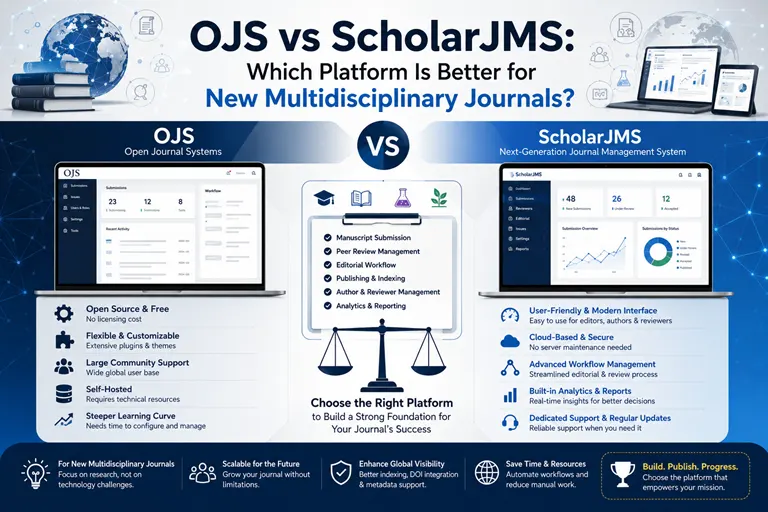
For multidisciplinary journals in particular, the challenge is even greater. Such journals receive submissions from diverse academic fields, manage authors and reviewers from different disciplines, and often require flexible editorial workflows that can adapt to varying manuscript types and peer review models.
Among the most widely discussed platforms are the widely used open-source platform Open Journal Systems (OJS) and the modern journal management platform ScholarJMS.
This article compares both platforms from the perspective of journal founders, editors, and publishers who are planning to establish a new multidisciplinary journal in 2026.
Why Choosing the Right Journal Platform Matters
A journal website is no longer just a place where articles are displayed.
Modern journals require:
- Online manuscript submission
- Reviewer management
- Editorial workflow automation
- DOI integration
- Publication ethics management
- Indexing readiness
- Author communication systems
- Long-term scalability
The wrong platform can result in administrative difficulties, delayed editorial decisions, technical problems, and poor author experiences.
For new journals that aim to build international credibility, choosing the right infrastructure from the beginning is essential.
Understanding OJS
Open Journal Systems is one of the most widely adopted journal management systems in academic publishing. Developed by the Public Knowledge Project, it provides an open-source solution for managing scholarly journals.
Strengths of OJS
OJS offers several advantages:
- Open-source software
- Large global user community
- Flexible customization options
- Extensive plugin ecosystem
- Suitable for technically experienced teams
- No software licensing costs
Thousands of journals worldwide have successfully used OJS for many years.
Limitations of OJS for New Journals
Despite its popularity, new journal owners often encounter several challenges.
Technical Complexity
Installing and maintaining OJS frequently requires:
- Server management
- Software updates
- Security maintenance
- Plugin configuration
- Backup management
- Technical troubleshooting
Many editorial teams lack dedicated technical personnel, making these tasks difficult.
Workflow Complexity
Although OJS is powerful, some editors find its workflow structure challenging to configure and manage, particularly during the early stages of journal development.
Custom Development Requirements
Many journals eventually require:
- Custom themes
- Workflow modifications
- Additional integrations
- Performance optimization
These requirements often increase operational costs.
Ongoing Maintenance Responsibilities
A journal using self-hosted OJS must continuously manage:
- Software upgrades
- Security patches
- Hosting issues
- Technical support
- Plugin compatibility
For many new journals, these responsibilities become burdensome.
Understanding ScholarJMS
ScholarJMS is a modern journal website and manuscript management platform specifically designed to simplify scholarly publishing.
The platform combines:
- Journal website management
- Manuscript submission
- Editorial workflows
- Reviewer management
- Publication processes
- Article publishing infrastructure
Its objective is to reduce technical complexity and allow editors to focus on research quality and journal development.
Why Multidisciplinary Journals Need Flexible Platforms
Multidisciplinary journals differ from highly specialized journals because they receive submissions from diverse subject areas.
They often manage:
- Scientific reports
- Review articles
- Case studies
- Methodological papers
- Applied research
- Interdisciplinary studies
Such journals require systems that can easily accommodate different workflows and editorial requirements.
OJS vs ScholarJMS: Feature Comparison
| Feature | OJS | ScholarJMS |
|---|---|---|
| Website Setup | Requires technical configuration | Ready-to-use journal setup |
| Manuscript Submission | Available | Available |
| Editorial Workflow | Configurable but complex | Streamlined and user-friendly |
| Reviewer Management | Available | Advanced workflow management |
| Hosting Management | User responsibility | Fully managed |
| Technical Maintenance | User responsibility | Managed service |
| DOI Workflow Support | Manual setup often required | Integrated guidance available |
| Journal Launch Support | Limited | Dedicated support available |
| OJS Migration Support | Not applicable | Professional migration support |
| New Journal Consulting | External requirement | Available through publishing support services |
| Suitable for Non-Technical Editors | Moderate | High |
User Experience for Editors and Authors
Modern authors expect submission systems that are:
- Simple
- Responsive
- Easy to navigate
- Mobile friendly
- Transparent
Editors increasingly prefer platforms that reduce administrative burden.
For newly established journals without dedicated IT teams, usability becomes a major deciding factor.
Scalability and Future Growth
Many new journals begin with a small number of submissions and gradually expand.
A platform should support:
- Increased submission volumes
- Larger reviewer databases
- Additional editorial roles
- International collaborations
- Indexing requirements
- Long-term sustainability
Scalability should be considered from the very beginning of journal planning.
Journal Launch Support Matters
Launching a journal involves far more than creating a website.
New publishers often require guidance regarding:
- Editorial policies
- Journal structure
- Publication ethics
- Website readiness
- ISSN applications
- DOI planning
- Metadata standards
- Indexing preparation
This is where comprehensive publishing support becomes extremely valuable.
Need Help Launching or Upgrading Your Journal?
We can help with:
- ScholarJMS journal website setup
- OJS migration
- Journal launch consulting
- Editorial workflow implementation
- ISSN consulting
- Crossref DOI guidance
- Publishing infrastructure planning
WhatsApp: +91 82003 85143
Email: inquiry@ojscloud.com
The Importance of ISSN Planning
Many new journals underestimate the importance of ISSN readiness.
Obtaining an ISSN requires:
- A properly structured journal website
- Publication policies
- Editorial information
- Journal metadata
- Publishing consistency
OJSCloud provides consulting support for journal founders seeking guidance on ISSN readiness and journal launch planning.
Professional assistance can significantly reduce delays and help ensure that journals satisfy the necessary requirements.
Why Crossref DOI Planning Should Begin Early
Digital Object Identifiers have become essential components of modern scholarly publishing.
DOIs help journals:
- Improve discoverability
- Enhance citation tracking
- Increase publication credibility
- Enable metadata distribution
- Support indexing initiatives
Many new journals struggle with:
- Crossref registration processes
- Metadata preparation
- DOI workflows
- Citation linking
GetDOI provides guidance and support for journals seeking assistance with DOI planning and implementation.
Need Support for DOI and Journal Infrastructure?
Our services include:
- Crossref DOI consulting
- Journal website setup
- ISSN readiness support
- Editorial workflow implementation
- OJS migration services
- Journal launch guidance
WhatsApp: +91 82003 85143
Email: inquiry@ojscloud.com
Transparency and Research Trust in Publishing
Academic publishing is increasingly moving toward:
- Transparent peer review
- Research integrity initiatives
- Open scholarly communication
- Ethical publishing practices
Platforms such as Scholar9 are contributing to the development of more transparent and trustworthy research ecosystems.
As scholarly communication evolves, journals that embrace transparency and modern workflows are likely to strengthen their credibility and international reputation.
Which Platform Is Better for New Multidisciplinary Journals?
The answer depends largely on the journal's resources and long-term goals.
OJS May Be Suitable If:
- You have technical expertise.
- You possess dedicated IT resources.
- You prefer complete software control.
- You can manage hosting and maintenance independently.
ScholarJMS May Be Suitable If:
- You want a modern and managed solution.
- You prefer simplified editorial workflows.
- You need launch support and consulting.
- You lack technical personnel.
- You require assistance with ISSN and DOI readiness.
- You wish to focus primarily on editorial quality and journal growth.
For many new multidisciplinary journals, the decision ultimately comes down to whether they prefer managing technical infrastructure themselves or partnering with a solution provider that handles much of the complexity.
Frequently Asked Questions
Is OJS free?
Yes. OJS is open-source software and can be used without licensing costs. However, hosting, maintenance, customization, and technical support may involve additional expenses.
Is ScholarJMS suitable for new journals?
Yes. ScholarJMS is designed to support new and emerging journals by simplifying journal setup and editorial workflows.
Can an existing OJS journal migrate to ScholarJMS?
Yes. Professional migration services are available for journals wishing to transition from OJS to modern journal management platforms.
Why do multidisciplinary journals need flexible workflows?
Because they often publish multiple manuscript types and manage submissions from diverse academic disciplines.
Is DOI planning necessary before publishing articles?
Yes. Early DOI planning helps establish proper metadata practices and improves discoverability and citation management.
Can publishers receive assistance with ISSN applications?
Yes. Professional consulting services can help journals prepare their websites and publishing infrastructure for ISSN readiness.
Conclusion
The success of a scholarly journal depends not only on its editorial quality but also on the strength of its publishing infrastructure.
Both OJS and ScholarJMS offer valuable capabilities, but they serve different needs. OJS remains a powerful solution for technically experienced publishers who prefer extensive customization and independent management. ScholarJMS, on the other hand, provides a modern, managed, and editor-friendly approach that is particularly attractive for new multidisciplinary journals seeking simplicity and professional support.
As multidisciplinary research continues to expand globally, journals require publishing platforms that are scalable, efficient, and capable of supporting international scholarly communication.
If you are planning to launch a new journal, modernize an existing publication, migrate from OJS, or seek guidance regarding ISSN and Crossref DOI readiness, professional assistance can simplify the journey and help establish a strong foundation for long-term success.
Contact Us
WhatsApp: +91 82003 85143
Email: inquiry@ojscloud.com