

Scientific Reports vs Review Articles: Choosing the Right Manuscript Type for Publication
Scientific Reports vs Review Articles: Choosing the Right Manuscript Type for Publication
One of the most common questions among researchers, particularly early-career scholars and doctoral students, is whether they should write a scientific report or a review article. Both manuscript types are highly valuable in scholarly communication, yet they serve different purposes and require different approaches to research and writing.
Choosing the appropriate manuscript type can significantly influence publication success, research visibility, and academic impact. Many manuscripts are rejected simply because authors submit the wrong type of paper to a journal or fail to structure their work according to the journal's expectations.
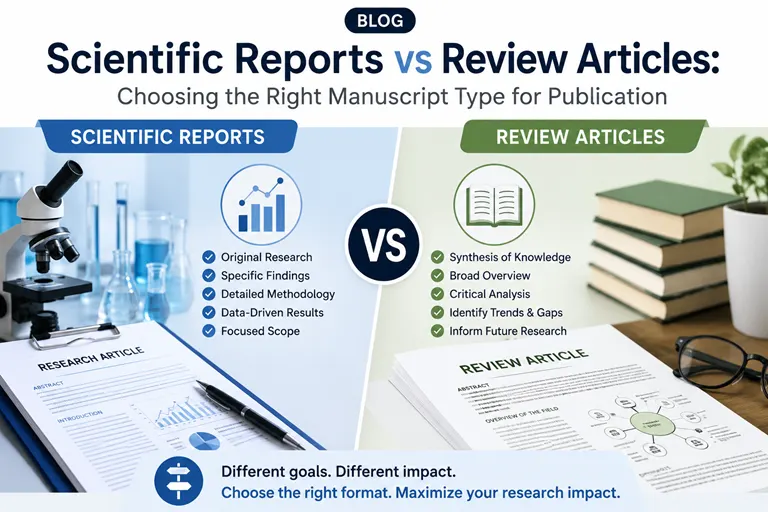
For multidisciplinary journals, understanding the distinction between scientific reports and review articles is particularly important because both manuscript categories contribute significantly to advancing scientific knowledge.
The International Research Journal of Scientific Reports and Reviews (IRJSRR) welcomes both original scientific reports and high-quality review articles that provide meaningful contributions across diverse disciplines.
This article explains the differences between these two manuscript types, their advantages, and how researchers can determine which format is most appropriate for their work.
Understanding Scientific Reports
A scientific report is an original research article that presents new findings obtained through experiments, observations, surveys, computational studies, or data analysis.
Scientific reports contribute new knowledge to a discipline by answering a research question or testing a specific hypothesis.
Characteristics of Scientific Reports
Scientific reports generally include:
- Original research findings
- Experimental or observational data
- Detailed methodology
- Statistical analysis
- Discussion of results
- Conclusions based on evidence
The purpose of a scientific report is to communicate new scientific discoveries that can be evaluated, replicated, and built upon by other researchers.
Typical Structure of a Scientific Report
Most scientific reports follow a standard structure:
- Title
- Abstract
- Keywords
- Introduction
- Materials and Methods
- Results
- Discussion
- Conclusion
- References
This structure ensures transparency and reproducibility in scientific research.
Examples of Scientific Reports
Examples include:
- Clinical research studies
- Engineering experiments
- Artificial intelligence model evaluations
- Environmental monitoring studies
- Social science surveys
- Agricultural field experiments
- Laboratory investigations
Scientific reports remain the primary mechanism through which new scientific discoveries are disseminated.
Understanding Review Articles
A review article does not present new experimental data. Instead, it critically examines and synthesizes previously published research on a specific topic.
Review articles help researchers understand the current state of knowledge, identify research gaps, and propose future directions.
Characteristics of Review Articles
Review articles typically include:
- Comprehensive literature analysis
- Critical evaluation of previous studies
- Identification of trends
- Comparison of methodologies
- Discussion of knowledge gaps
- Recommendations for future research
Review articles are highly valuable because they save researchers considerable time by organizing large volumes of scientific information.
Types of Review Articles
Several forms of review articles exist.
Narrative Reviews
Narrative reviews provide a broad overview of a topic and discuss important findings from previous studies.
Systematic Reviews
Systematic reviews follow predefined methodologies to identify, evaluate, and synthesize relevant evidence.
Scoping Reviews
Scoping reviews map the available literature and identify emerging research themes.
Meta-Analyses
Meta-analyses statistically combine findings from multiple studies to produce more robust conclusions.
Each review type serves a different purpose and should be selected according to the research objectives.
Scientific Reports vs Review Articles: Major Differences
| Feature | Scientific Reports | Review Articles |
|---|---|---|
| Primary Purpose | Present new findings | Summarize existing knowledge |
| Data Source | Original research data | Published literature |
| Methodology | Experiments, surveys, observations | Literature search and synthesis |
| Research Contribution | Generates new evidence | Integrates existing evidence |
| Statistical Analysis | Usually required | Depends on review type |
| Research Questions | Specific and focused | Broad and analytical |
| Time Requirement | Data collection may take months or years | Extensive literature analysis required |
| Citation Potential | Moderate to high | Often very high |
| Future Research Guidance | Limited | Extensive |
Both manuscript types are equally important but serve different scientific objectives.
When Should You Write a Scientific Report?
A scientific report is usually appropriate when you have:
- Conducted original experiments
- Collected primary data
- Performed surveys or observations
- Developed a new methodology
- Tested a hypothesis
- Generated novel findings
Researchers who have completed a funded project, doctoral research, or laboratory investigation generally prepare scientific reports.
Advantages of Publishing Scientific Reports
Scientific reports offer several benefits:
- Establish research credibility
- Demonstrate original contributions
- Improve academic reputation
- Support evidence-based practice
- Enable replication and validation
- Contribute directly to scientific advancement
Original research publications are often essential for academic promotion and research funding applications.
When Should You Write a Review Article?
A review article is generally appropriate when:
- A large volume of literature exists on a topic.
- Researchers need an evidence summary.
- A field is rapidly evolving.
- Research gaps need to be identified.
- Future research directions need to be proposed.
Review articles are particularly valuable in emerging areas where knowledge is expanding rapidly.
Advantages of Publishing Review Articles
Review articles provide several advantages:
- Often receive high citation rates.
- Build subject expertise and authority.
- Improve academic visibility.
- Help define future research directions.
- Facilitate interdisciplinary understanding.
- Serve as educational resources.
Many highly cited academic papers are review articles because they become essential reference sources.
Which Manuscript Type Is Easier to Publish?
There is no universal answer to this question.
Scientific reports require:
- Original data collection
- Research ethics approval where applicable
- Statistical analysis
- Methodological rigor
Review articles require:
- Extensive literature searching
- Critical analysis
- Comprehensive synthesis
- Strong academic writing skills
The difficulty depends largely on the author's experience, available resources, and research objectives.
Citation Impact: Scientific Reports vs Review Articles
Review articles frequently receive more citations because they summarize large bodies of knowledge and become useful reference documents.
However, groundbreaking scientific reports can also achieve substantial impact if they introduce novel methods or significant discoveries.
Both manuscript types contribute meaningfully to scholarly communication.
Importance for Multidisciplinary Research
Multidisciplinary journals increasingly publish both scientific reports and review articles because modern research problems often require integrated knowledge from multiple disciplines.
Examples include:
- Artificial intelligence in healthcare
- Climate change and public policy
- Precision medicine and genomics
- Sustainable engineering
- Data science and business analytics
- Smart agriculture and environmental science
Scientific reports provide new evidence, while review articles synthesize knowledge across disciplines.
Together, they accelerate scientific progress.
Common Mistakes Authors Make
Researchers often encounter difficulties because they misunderstand manuscript expectations.
Common mistakes include:
- Submitting a literature summary as an original research article.
- Presenting insufficient data in a scientific report.
- Writing a review without critical analysis.
- Ignoring journal author guidelines.
- Selecting an inappropriate manuscript type.
- Failing to define research objectives clearly.
Understanding journal requirements before submission significantly improves publication success.
How to Decide Which Manuscript Type to Choose
Consider the following questions:
Do you have original data?
If yes, a scientific report is likely the appropriate choice.
Is your objective to summarize existing evidence?
If yes, a review article may be more suitable.
Is the research area rapidly developing?
A review article can provide substantial value.
Have you generated novel findings?
A scientific report should be considered.
Are there significant research gaps?
A review article may help identify future directions.
The decision should always align with the nature of the research and the objectives of the manuscript.
Tips for Publishing Success
Regardless of manuscript type, authors should:
- Select an appropriate journal.
- Follow author guidelines carefully.
- Write clear and concise abstracts.
- Use robust methodology.
- Cite relevant literature.
- Maintain ethical research practices.
- Ensure high-quality scientific writing.
Careful preparation greatly improves the chances of successful publication.
The Role of Multidisciplinary Journals
Multidisciplinary journals play a vital role in scholarly communication by providing a platform for diverse forms of research.
The International Research Journal of Scientific Reports and Reviews (IRJSRR) encourages the submission of:
- Original scientific reports
- Narrative reviews
- Systematic reviews
- Interdisciplinary studies
- Methodological papers
- Evidence syntheses
By publishing both scientific reports and review articles, multidisciplinary journals facilitate knowledge exchange and encourage collaboration across academic disciplines.
Frequently Asked Questions
What is the difference between a scientific report and a review article?
A scientific report presents original research findings, whereas a review article synthesizes and evaluates previously published studies.
Which manuscript type receives more citations?
Review articles often receive higher citation counts because they serve as comprehensive reference sources.
Can a review article include original data?
Generally, no. Review articles focus on previously published evidence, although meta-analyses may include statistical synthesis of published data.
Are scientific reports more difficult to write?
Scientific reports require original research and data analysis, whereas review articles demand extensive literature evaluation. Both require significant effort.
Which manuscript type is better for early-career researchers?
Both can be valuable. Scientific reports demonstrate original research capability, while review articles help establish subject expertise.
Can multidisciplinary journals publish both manuscript types?
Yes. Many multidisciplinary journals actively encourage submissions of both scientific reports and review articles.
Conclusion
Scientific reports and review articles are both essential pillars of scholarly communication. Scientific reports generate new knowledge through original research, while review articles synthesize existing evidence and guide future investigations.
Neither manuscript type is inherently superior. The appropriate choice depends on the research objectives, available data, and the contribution the author intends to make to the scientific community.
For researchers working in multidisciplinary environments, understanding the strengths of both manuscript types is increasingly important. Modern scientific challenges demand both the creation of new evidence and the synthesis of existing knowledge.
The International Research Journal of Scientific Reports and Reviews remains committed to publishing high-quality scientific reports and review articles that contribute to global scholarship, interdisciplinary collaboration, and scientific advancement.
Editors and scholarly societies planning to establish new multidisciplinary journals or modernize their publishing infrastructure may also benefit from professional support for journal website development, editorial workflow setup, ISSN consulting, Crossref DOI guidance, and journal management solutions through platforms such as ScholarJMS, OJSCloud, GetDOI, and Scholar9.