


Why Multidisciplinary Journals Need a Modern Manuscript Submission and Peer Review System
Why Multidisciplinary Journals Need a Modern Manuscript Submission and Peer Review System
The scholarly publishing ecosystem has undergone a significant transformation over the past decade. Research output is increasing rapidly, international collaborations are expanding, and authors now expect journals to provide seamless digital experiences from manuscript submission to final publication.
For multidisciplinary journals, these expectations are even greater. Unlike highly specialized journals, multidisciplinary publications receive submissions from a wide range of disciplines, methodologies, and manuscript types. Managing this diversity efficiently requires more than a simple website or email-based submission process.
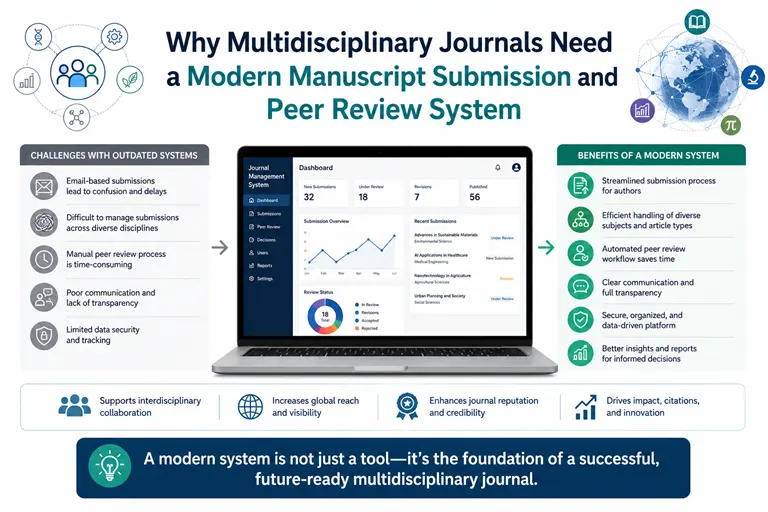
A modern manuscript submission and peer review system has become an essential component of successful journal publishing. It improves editorial efficiency, enhances author satisfaction, supports research integrity, and creates a strong foundation for long-term growth.
The International Research Journal of Scientific Reports and Reviews (IRJSRR) recognizes the importance of robust publishing infrastructure in supporting high-quality interdisciplinary scholarship and efficient editorial management.
The Growing Complexity of Multidisciplinary Publishing
Modern multidisciplinary journals often publish:
- Original research articles
- Scientific reports
- Review articles
- Case studies
- Methodological papers
- Short communications
- Interdisciplinary studies
Each manuscript type may require different editorial processes, reviewer expertise, and evaluation criteria.
As submission volumes grow, manual workflows become increasingly difficult to manage.
The Limitations of Traditional Submission Methods
Many emerging journals initially rely on:
- Email submissions
- Spreadsheet tracking
- Manual reviewer assignments
- Basic website forms
- Separate communication tools
While these approaches may work temporarily, they become inefficient as the journal grows.
Common Challenges of Manual Systems
Editorial teams frequently encounter:
- Lost manuscripts
- Delayed reviewer assignments
- Communication errors
- Inconsistent tracking
- Administrative overload
- Difficulty generating reports
- Limited transparency
These challenges can negatively affect both authors and reviewers.
Why Authors Expect Modern Submission Systems
Researchers today are accustomed to digital platforms that provide convenience and transparency.
Authors expect to:
- Submit manuscripts online
- Track manuscript status
- Receive automated notifications
- Upload revisions easily
- Access reviewer comments securely
- Communicate efficiently with editors
A poor submission experience can discourage future submissions and affect a journal's reputation.
Why Reviewer Management Has Become More Complex
Peer review remains the foundation of scholarly publishing. However, managing reviewers has become increasingly challenging.
Editorial teams must:
- Identify suitable reviewers
- Avoid conflicts of interest
- Monitor review timelines
- Send reminders
- Track reviewer performance
- Maintain confidentiality
Without an organized system, reviewer management can quickly become overwhelming.
The Importance of Efficient Editorial Workflows
A modern journal management system streamlines every stage of publishing.
Typical workflows include:
- Manuscript submission
- Initial editorial screening
- Reviewer assignment
- Peer review
- Revision management
- Final decision
- Copyediting and production
- Publication
Automating these processes significantly improves efficiency and reduces administrative burden.
Benefits of Modern Manuscript Submission Systems
Modern journal management platforms offer numerous advantages.
Improved Author Experience
Authors benefit from:
- Easy submissions
- Real-time tracking
- Faster communication
- Reduced administrative delays
- Better transparency
Positive author experiences encourage repeat submissions and increase journal credibility.
Enhanced Reviewer Management
Editors can:
- Maintain reviewer databases
- Track review performance
- Send automatic reminders
- Monitor deadlines
- Generate reviewer reports
Efficient reviewer management leads to faster editorial decisions.
Better Editorial Oversight
Editors gain access to:
- Submission dashboards
- Workflow monitoring
- Decision histories
- Performance analytics
- Communication records
These features help maintain consistency and improve journal governance.
Increased Publishing Efficiency
Modern systems reduce:
- Manual administrative work
- Human error
- Delays in communication
- Workflow bottlenecks
- Duplicate tasks
As a result, journals can handle larger submission volumes without increasing administrative complexity.
Why Multidisciplinary Journals Need Flexible Workflows
Multidisciplinary journals rarely follow a single editorial model.
A manuscript in engineering may require a different review process than a manuscript in public health or management science.
A modern system should support:
- Multiple manuscript categories
- Diverse editorial structures
- Custom workflows
- Variable review models
- Interdisciplinary reviewer databases
Flexibility is essential for managing diverse research communities.
Supporting International Collaboration
Most multidisciplinary journals receive submissions from authors and reviewers across multiple countries.
A modern platform facilitates:
- Global accessibility
- Time-zone independent communication
- Centralized manuscript management
- International reviewer participation
- Efficient editorial coordination
This capability is increasingly important in today's interconnected research environment.
The Role of Automation in Scholarly Publishing
Automation has become a critical component of modern journal management.
Automated systems can:
- Send submission confirmations
- Issue reviewer invitations
- Generate reminders
- Notify editorial decisions
- Produce workflow reports
- Manage publication schedules
Automation allows editors to focus more on research quality and less on administrative tasks.
The Importance of Research Integrity and Transparency
Research integrity expectations continue to increase.
Modern publishing systems can support:
- Ethical declarations
- Conflict of interest management
- Reviewer confidentiality
- Audit trails
- Decision documentation
- Policy compliance
Transparent workflows improve trust among authors, reviewers, and readers.
Why Indexing Readiness Depends on Strong Infrastructure
Indexing agencies increasingly expect journals to demonstrate:
- Editorial consistency
- Publication regularity
- Proper metadata management
- Transparent policies
- High publishing standards
A modern journal management system helps maintain these requirements and supports long-term journal development.
Choosing the Right Journal Management Platform
When selecting a manuscript submission and peer review system, publishers should consider:
- Ease of use
- Scalability
- Technical support
- Workflow flexibility
- Security
- DOI integration capabilities
- Reporting functions
- Long-term sustainability
The platform should align with the journal's objectives and future growth plans.
Why Many New Journals Prefer Managed Publishing Solutions
Many editors and scholarly societies prefer managed solutions because they reduce technical burdens and simplify journal operations.
ScholarJMS offers:
- Journal website development
- Online manuscript submission
- Editorial workflow management
- Reviewer management tools
- Publication infrastructure
- User-friendly administration
- Long-term technical support
Such solutions allow editorial teams to concentrate on publishing quality rather than software management.
Need Help Building or Upgrading Your Journal Infrastructure?
We can help with:
- New journal website setup
- ScholarJMS implementation
- Editorial workflow configuration
- Manuscript submission systems
- Peer review management solutions
- Journal launch consulting
- Technical support and training
WhatsApp: +91 82003 85143
Email: inquiry@ojscloud.com
The Importance of DOI and Metadata Workflows
Modern manuscript systems should also support:
- DOI registration planning
- Metadata management
- Article discoverability
- Citation tracking
- Long-term digital preservation
GetDOI provides support and guidance for journals planning Crossref DOI workflows and metadata implementation.
Why Journal Launch Consulting Matters
Many new journals underestimate the complexity of establishing sustainable publishing operations.
Launching a journal involves:
- Website development
- Editorial policies
- ISSN readiness
- DOI planning
- Workflow configuration
- Publication ethics implementation
- Long-term publishing strategy
OJSCloud provides consulting and support services for journals seeking assistance with journal launch planning, ISSN readiness, and publishing infrastructure.
The Future of Transparent Peer Review
The scholarly publishing community is increasingly moving toward:
- Transparent peer review
- Open scholarly communication
- Research integrity initiatives
- Trust-based publishing ecosystems
Scholar9 supports the development of transparent and trustworthy scholarly communication practices.
Common Signs That a Journal Needs a Better System
A journal may need to modernize its infrastructure if it experiences:
- Increasing manuscript delays
- Difficulty managing reviewers
- Excessive email communication
- Lack of submission tracking
- Poor author satisfaction
- Administrative overload
- Irregular workflows
Modernization often leads to significant improvements in operational efficiency.
Frequently Asked Questions
Why do multidisciplinary journals need specialized submission systems?
Because they manage diverse manuscript types, interdisciplinary research areas, and complex editorial workflows.
Can a modern system improve publication speed?
Yes. Automation and workflow management significantly reduce administrative delays.
Is peer review management important for new journals?
Absolutely. Efficient peer review improves publication quality, author satisfaction, and journal credibility.
Can journals migrate from older systems?
Yes. Existing journals can migrate to modern platforms and improve their publishing workflows.
Why is metadata management important?
Metadata improves discoverability, indexing readiness, citation tracking, and long-term visibility.
Do modern systems help with research integrity?
Yes. They support transparency, documentation, ethical compliance, and workflow accountability.
Conclusion
The future of scholarly publishing depends not only on high-quality research but also on the strength of the publishing infrastructure that supports it.
Multidisciplinary journals face unique challenges because they manage diverse research communities, manuscript types, and editorial processes. A modern manuscript submission and peer review system enables journals to address these challenges efficiently while improving author experience, reviewer management, and editorial quality.
As research output continues to grow and international collaborations become increasingly common, investing in modern publishing technology is no longer optional. It is an essential component of sustainable and credible scholarly publishing.
For journals planning to launch, expand, or modernize their editorial operations, professional support with journal websites, manuscript submission systems, editorial workflows, ISSN consulting, DOI implementation, and publishing strategy can significantly simplify the journey and create a strong foundation for long-term success.
Contact Us
WhatsApp: +91 82003 85143
WhatsApp Direct: https://wa.me/918200385143
Email: inquiry@ojscloud.com